Confidential Delaware Nursing Home Neglect & Wrongful Death Settlement
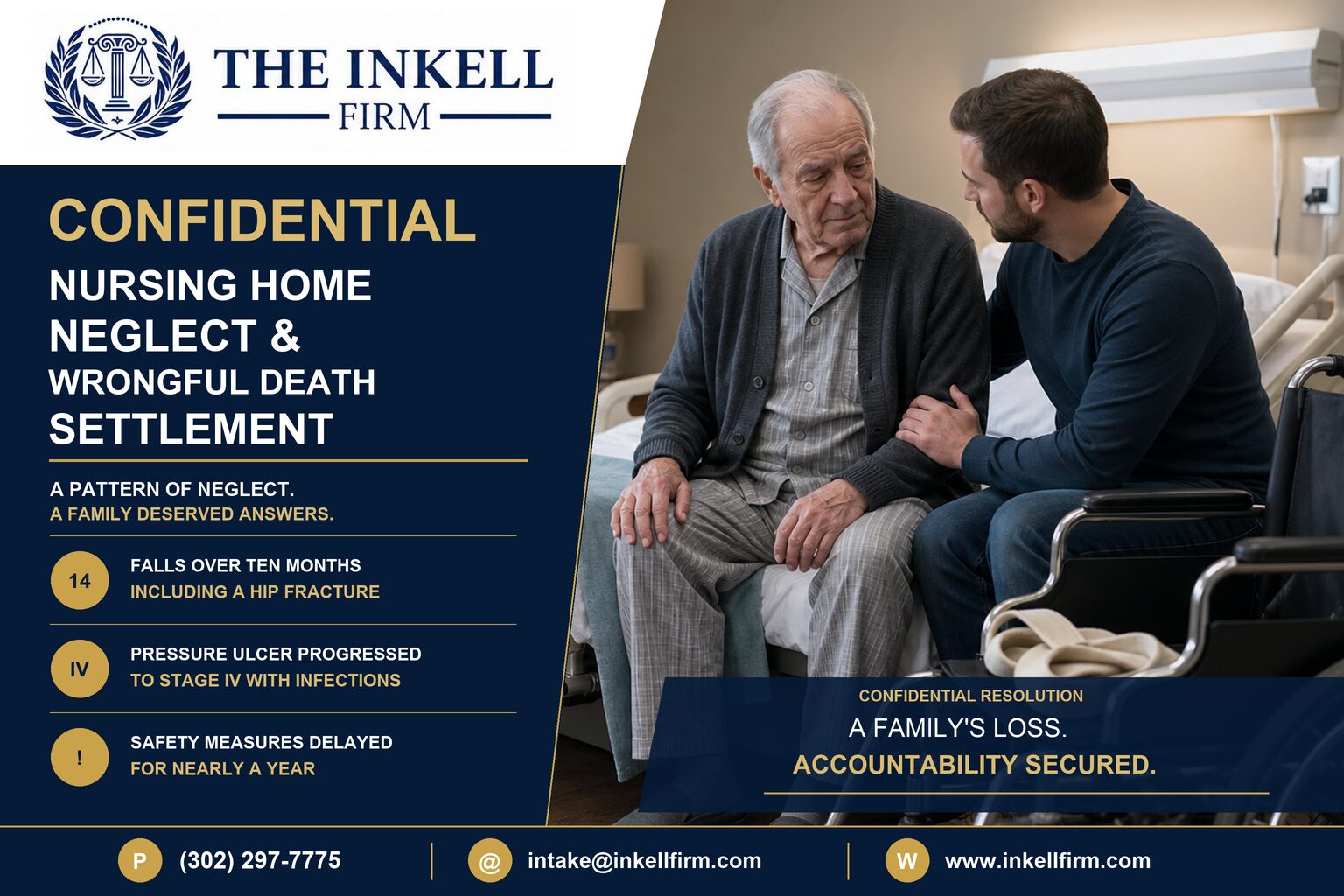
The Inkell Firm secured a confidential settlement in a Delaware nursing home negligence case involving an elderly resident who suffered more than a dozen falls, a worsening pressure ulcer, and repeated infections before her death, after the facility failed to act on months of documented warning signs.
This case was about far more than a single injury. It was about a pattern: falls that kept happening, a wound that kept getting worse, and a facility that waited nearly a year to put basic safety measures in place.
Case Summary
- Settlement Amount: Confidential
- Case Type: Nursing Home Negligence / Wrongful Death
- Location: Wilmington, Delaware
- Key Issue: Repeated falls and a deteriorating pressure ulcer in a resident dependent on staff for care, resulting in death
- Result: Confidential settlement secured for the resident’s family
A Pattern of Falls the Facility Failed to Address
Our client’s mother was admitted to a Wilmington-area nursing and rehabilitation facility for long-term custodial care. Over the following ten months, she fell fourteen separate times, one of which fractured her hip and required emergency surgery. The facility knew she was at risk for falls from the outset, yet it did not add meaningful fall-prevention measures, a low bed, floor mats, and a Hoyer lift for transfers, until nearly a year after her first fall.
A Pressure Ulcer That Was Allowed to Progress to Stage IV
At the same time, the facility failed to reposition her as ordered, and a pressure sore on her coccyx and buttocks developed and was allowed to deteriorate. She was transferred to area hospitals multiple times for infections tied directly to that wound, including an infected feeding tube, an infected gallbladder, and sepsis. By the time the facility readmitted her for the final time, the ulcer had reached stage IV with exposed bone.
A Family That Raised the Alarm, Repeatedly
Her daughter raised concerns with facility staff throughout the admission. On one occasion, she arrived to find her mother unresponsive; when the treating physician dismissed her concerns, she called 911 herself and had her mother transported to the hospital. She passed away several months later.
Building the Case: Staffing, Not Just a Single Mistake
The Inkell Firm filed suit in the Delaware Superior Court on behalf of the resident’s estate and her daughter, asserting survival, wrongful death, breach of fiduciary duty, and negligence per se claims arising from the facility’s violations of federal nursing home regulations (42 C.F.R. Part 483). The complaint also sought punitive damages, alleging that the facility’s short-staffing was a corporate decision made to maximize profit at the expense of resident safety, a familiar pattern in nursing home neglect cases.
The facility moved to dismiss a portion of the claims; the firm briefed and argued the motion and preserved the core negligence, fiduciary duty, and wrongful death counts. The firm then retained nursing and geriatric care experts to establish the standard of care and causation, tying the facility’s failure to reposition, monitor, and timely treat the resident directly to her decline and death, and pursued the claim through discovery and mediation.
Why Staffing Matters in Nursing Homes
Many nursing home neglect cases, including this one, trace back to inadequate staffing. When facilities operate with too few caregivers, residents who depend on staff for repositioning, supervision, and mobility assistance are the first to suffer. That can lead to:
- Falls during transfers or unsupervised moments
- Pressure injuries and skin breakdown
- Delayed recognition and treatment of infection
- Inadequate monitoring of high-risk residents
- Missed or dismissed family concerns
Holding the Facility Accountable
Cases like this one are about dignity and accountability as much as compensation. Families trust nursing homes to safely care for loved ones who can no longer fully protect themselves. When facilities fail to staff and supervise appropriately, the consequences can be fatal.
At The Inkell Firm, we represent families in:
- Nursing home abuse and neglect cases
- Nursing home fall cases
- Pressure ulcer / bedsore cases
- Nursing home wrongful death claims
- Nursing home understaffing cases
You can also review another nursing home result here: $750,000 Nursing Home Settlement.
Frequently Asked Questions
Can a nursing home be held liable for repeated falls?
Yes. Once a facility identifies a resident as a fall risk, it has a duty to implement and adjust interventions, such as low beds, floor mats, transfer assistance, and supervision, to prevent further falls. A pattern of repeated falls without escalating intervention can support a negligence claim.
How do pressure ulcers become evidence of neglect?
Pressure ulcers are largely preventable with regular repositioning, proper nutrition, and wound care. When a wound is allowed to progress to an advanced stage, such as stage IV with exposed bone, medical records can show exactly where care fell short.
What is a survival claim in a Delaware nursing home case?
A survival claim allows a personal representative to pursue damages for the injuries and suffering the resident experienced during her lifetime, separate from the wrongful death claim brought on behalf of surviving family members.
What compensation may be available in a nursing home wrongful death case?
Compensation may include damages for the resident’s pain and suffering before death, medical expenses, funeral expenses, and damages available to surviving family members under Delaware’s wrongful death statute.
How do I know if my loved one’s nursing home injury involved negligence?
Warning signs include unexplained or repeated falls, inconsistent explanations from staff, delayed transfers to the hospital, understaffing, and pressure wounds or infections that were not properly treated.
Contact The Inkell Firm
If you believe your loved one suffered harm because of nursing home neglect or unsafe staffing practices, contact The Inkell Firm to discuss your options.
Call: (302) 297-7775
Email: intake@inkellfirm.com
Contact Page: https://inkellfirm.com/contact-us/
Disclaimer: Every case is different. Past results do not guarantee future outcomes. Names and identifying details have been withheld to protect the family’s privacy. This article is for informational purposes only and does not constitute legal advice.