
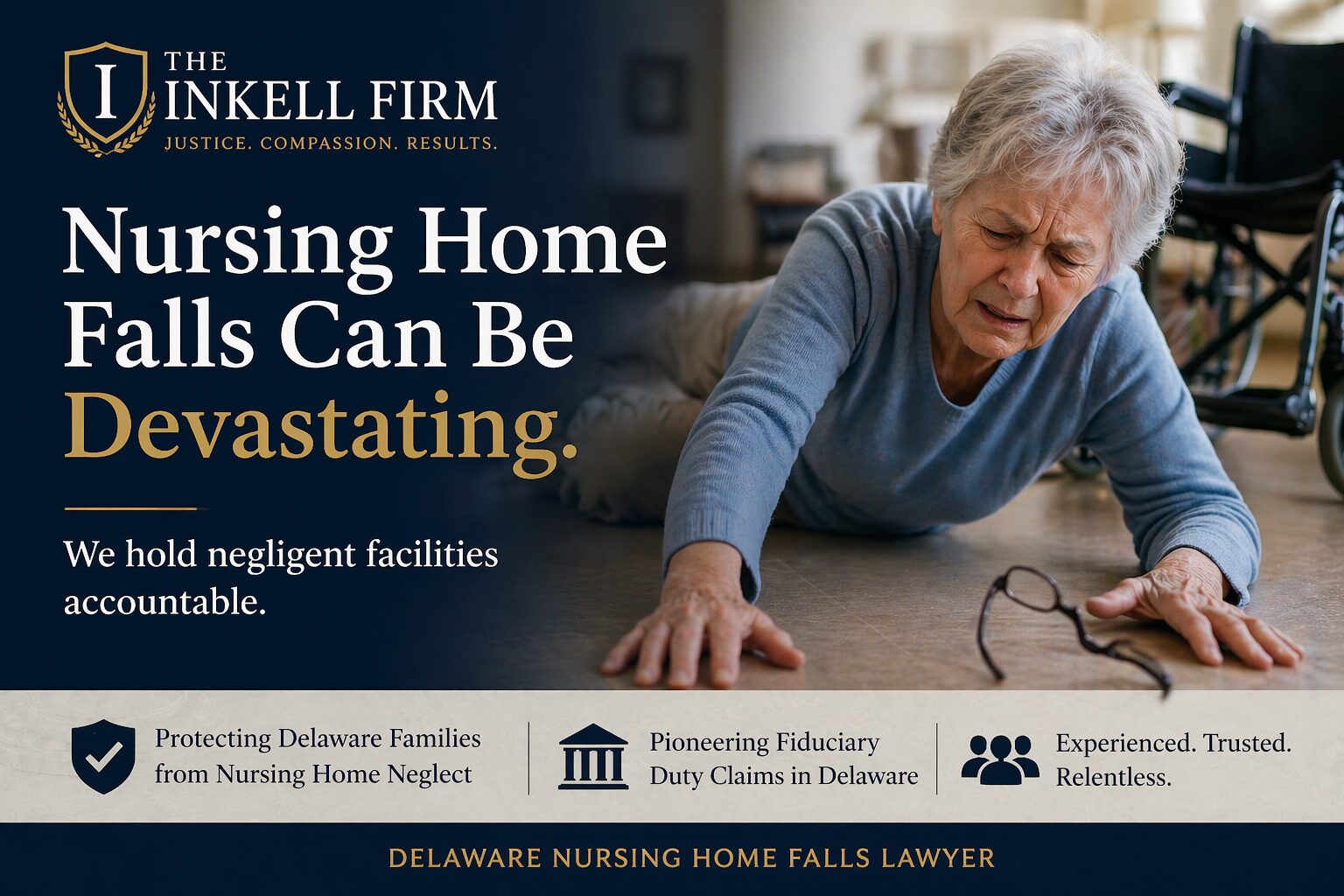
Delaware Nursing Home Falls Lawyer
A serious nursing home fall is often described as an accident. In many cases, it is not. Falls in nursing homes can happen when staff ignore known fall risks, fail to supervise vulnerable residents, miss toileting needs, use unsafe transfer techniques, or do not follow the resident’s care plan. The Inkell Firm helps Delaware families investigate whether a fall was preventable and whether the nursing home failed to protect a resident who depended on it for daily safety and care.
We handle nursing home fall cases involving hip fractures, head trauma, brain bleeds, internal injuries, immobility, surgery, rapid decline, and wrongful death. In these cases, the most important question is often not simply how the fall happened, but why it happened and whether the nursing home should have prevented it.
Why nursing home falls are such a serious issue
Falls are one of the most dangerous events an older adult can suffer. According to the Centers for Disease Control and Prevention, falls are the leading cause of injury for adults age 65 and older and the leading cause of both fatal and nonfatal injuries among older adults. You can review the CDC resource here:
CDC Falls Data and Research.
In the nursing home setting, that risk is even more important because residents are often frail, cognitively impaired, weak, recovering from illness, taking medications that affect balance, or dependent on staff for transfers and toileting. A fall can be life-changing. It may lead to a broken hip, brain injury, surgery, hospitalization, immobility, infection, loss of independence, or death.
Why falls happen in nursing homes
Many families are told some version of the same story after a fall: the resident “just got up on their own,” “lost balance,” or “fell despite precautions.” Sometimes that is incomplete. Falls often happen after a chain of preventable problems, including poor staffing, delayed response times, missed assessments, medication issues, or failures to follow known safety measures.
Failure to identify fall risk
Residents should be assessed for fall risk on admission and reassessed after medication changes, illness, weakness, confusion, or a prior fall. When the assessment is missing, outdated, or inaccurate, the resident may not receive the precautions they need.
Inadequate supervision
Some residents need close monitoring because they are impulsive, confused, weak, or prone to trying to stand without help. Unanswered call bells, delayed staff response, and understaffing can directly contribute to falls.
Unsafe transfers
Falls often occur during transfers from bed to wheelchair, wheelchair to toilet, or while ambulating with assistance. If staff fail to use a gait belt, ignore two-person assist requirements, or use poor transfer technique, the result can be catastrophic.
Missed toileting assistance
Many residents try to get up on their own when help does not come in time. When a resident is known to need assistance but staff do not respond promptly, a “self-transfer” fall may actually reflect neglect.
Medication side effects
Sedatives, psychoactive medications, blood pressure medications, pain medications, and other drugs can increase dizziness, instability, confusion, and weakness. Facilities should recognize those effects and adjust fall precautions accordingly.
Failure to follow precautions
Bed alarms, chair alarms, low beds, floor mats, proper footwear, wheelchair positioning, toileting schedules, and individualized care plans all matter. When the nursing home knows what should be done but does not do it, the fall may have been preventable.
Understaffing is often at the center of serious fall cases
In many of our prior cases, the evidence shows that the facility was not staffed appropriately to provide a safe environment for residents. A nursing home may have policies on paper about supervision, toileting assistance, transfers, rounding, alarms, and response times, but those protections fail when there are not enough staff members on the floor to carry them out.
Federal payroll data
We often examine federally required payroll data to evaluate whether the facility had the staffing it claims it had and whether staffing levels were consistent with safe resident care.
Facility staffing records
We review assignment sheets, schedules, staffing documents, call-light records, nursing notes, and other facility materials to understand how many people were actually available to supervise and assist residents when the fall happened.
Depositions of current and former employees
Depositions can reveal what day-to-day staffing looked like in practice. Current and former employees may testify about missed rounds, delayed responses, rushed transfers, too many residents per caregiver, and whether the facility could realistically provide the care residents needed.
Serious injuries caused by nursing home falls
Nursing home falls are not minor events. Even when a resident survives the initial injury, the consequences may continue for weeks, months, or permanently. A fall can trigger a cascade of complications that changes the resident’s health and independence.
Hip fractures and broken bones
Hip fractures are among the most devastating fall injuries for older adults. They often require surgery, hospitalization, painful rehabilitation, and prolonged immobility. Many residents never return to their prior level of functioning after a serious fracture.
Head trauma and brain bleeding
A resident who strikes their head may suffer a concussion, subdural hematoma, intracranial bleeding, or other neurological injury. These injuries can be especially dangerous when the facility delays recognizing symptoms or delays transfer to the hospital.
Loss of mobility and rapid decline
After a fall, some residents become afraid to walk, lose strength, remain in bed more often, develop pressure injuries, suffer infections, or begin a downward spiral in function and health. The fall may be the event that changes everything.
Wrongful death
Some falls lead to fatal complications. Those may include surgery-related complications, immobility, infection, pneumonia, brain injury, bleeding, or other medical decline after the fall. In severe cases, a family may have a wrongful death claim.
How to tell whether a fall may involve neglect
Not every fall automatically proves negligence. But many fall cases deserve close review. The facility’s explanation may not tell the full story, and the real evidence may be found in the chart, care plan, medication records, staffing conditions, and what happened in the hours or days leading up to the fall.
Warning signs families should look for
- Repeated falls or near-falls
- Conflicting explanations from different staff members
- Known confusion or wandering before the incident
- Evidence that the resident tried to toilet alone
- Missing alarms, call-light delays, or lack of assistive devices
- A care plan that does not match the resident’s actual condition
- Sudden bruising, fractures, head injury, or hospitalization
Questions that often matter legally
- Was the resident identified as a fall risk?
- What precautions were ordered, and were they followed?
- Had the resident fallen before?
- Did medications increase the risk of dizziness or confusion?
- Was staffing adequate at the time of the fall?
- Was the resident supposed to receive one-person or two-person assistance?
- Did the nursing home delay treatment or fail to report the incident accurately?
Reporting suspected abuse, neglect, or serious safety concerns in Delaware
Delaware families do not have to stay silent if they believe a nursing home fall may have involved abuse, neglect, poor supervision, unsafe staffing, or other quality-of-care failures. The Delaware Department of Health and Social Services provides a reporting portal through the Division of Health Care Quality for abuse, neglect, mistreatment, patient or client rights concerns, quality-of-care concerns, and staffing concerns.
You can report suspected abuse or neglect, including concerns connected to a serious fall, here:
Delaware DHSS DHCQ Report Abuse Portal.
What The Inkell Firm does in nursing home fall cases
Incident reports rarely tell the full story. Our job is to look beyond the nursing home’s immediate explanation and determine whether the resident’s injuries were the result of a preventable failure in care.
Review the records
We examine fall-risk assessments, care plans, transfer instructions, nursing notes, medication records, prior incident history, hospital records, and other documentation to understand whether the resident was properly protected.
Look for a pattern
Many serious falls do not happen in isolation. There may have been prior falls, known impulsive behavior, a decline in strength, medication changes, understaffing, or repeated failures to follow precautions.
Show the full harm
We work to show not only the immediate injury but the full impact of the fall, including surgery, pain, rehabilitation, immobility, emotional suffering, complications, and the losses experienced by the resident and family.
Frequently asked questions about nursing home falls
Are nursing home falls always negligence?
No. Not every fall automatically proves negligence. But many nursing home falls are preventable. A claim may exist when the facility failed to assess fall risk, provide supervision, respond to call lights, follow care plans, or use appropriate precautions.
What injuries can result from a nursing home fall?
Falls can cause hip fractures, broken bones, head trauma, brain bleeds, spinal injuries, surgery, hospitalization, immobility, and wrongful death.
What if the nursing home says the resident just tried to get up alone?
That does not end the inquiry. The important questions are why the resident tried to get up alone, whether help was delayed, whether the resident was known to do that, and whether the nursing home had appropriate supervision and precautions in place.
Can understaffing play a role in a nursing home fall case?
Yes. In many cases, understaffing is a major issue. If there were not enough staff members to monitor residents, assist with toileting, perform safe transfers, or respond to call lights, the fall may reflect a larger failure by the facility to provide a safe environment.
When should I call a Delaware nursing home falls lawyer?
You should contact a lawyer as soon as possible after a serious fall, especially if it involved a fracture, hospitalization, head injury, repeated falls, or signs that the nursing home ignored known fall risks.
Speak with a Delaware nursing home falls lawyer
If your loved one suffered a serious fall in a nursing home, The Inkell Firm can investigate whether the injury was preventable and whether the facility failed to protect a vulnerable resident. We can review the records, the precautions, the supervision, the staffing, and the care plan to determine whether the fall should never have happened.
Attorney advertising. Prior results do not guarantee a similar outcome. This page is for informational purposes only and does not create an attorney-client relationship.